As the European Union pushes for the expansion of aquaculture across its waters, Greece confronts a deeper question: can industrial fish farming expand along its iconic shores without destroying the ecosystems and coastal communities that depend on them?
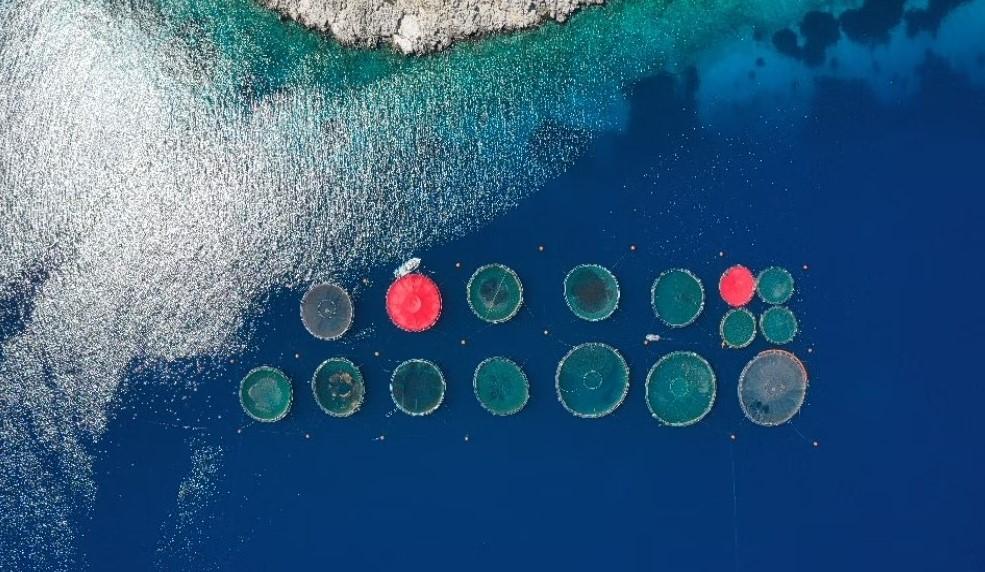
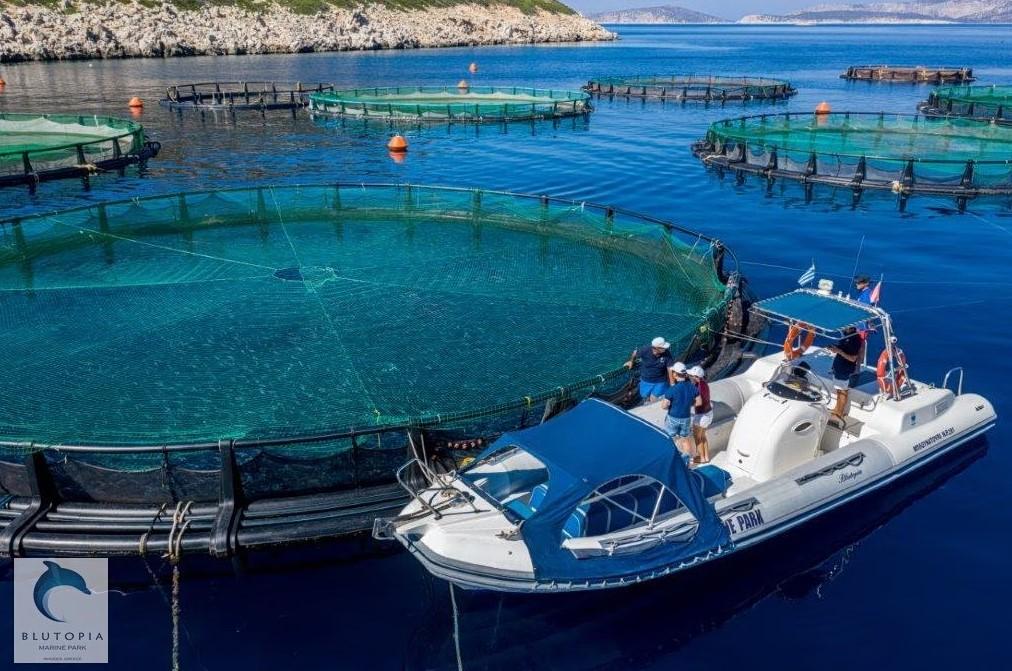
Nestled off the western coast of Rhodes inside a protected Natura 2000 marine zone, a cluster of floating cages marks one of Greece’s smallest commercial fish farms- Lamar SA. The company produces roughly 320 tons of fish a year from just 10 hectares of leased sea space- the smallest size of rentable space allowed by the Greek government.
The farm raises four species, including sea bass and sea bream, and in a fish farm-to- fork approach, supplies hotels and restaurants on Rhodes and surrounding islands throughout Greece’s long tourist season.
Talking to TO BHMA International Edition in his bright office on Rhodes, its CEO, Savvas Chatzinikolaou, describes the family operation as deliberately small-scale and sustainability-focused. It aims to “flip the coin” on traditional fish farming through what he calls sustainable aquaculture tourism.
In an effort to dispel misconceptions about the compatibleness of fish farms with Natura 2000 sites, Lamar opens its commercial operations to the public through a sister company called Blutopia, which enables visitors to examine water quality, fish health and local biodiversity up close. “We want people to see how this works, not just read reports.”
But Lamar’s future isn’t only constrained by environmental preconceptions; there are bureaucratic constraints, too. Because the company operates outside a designated aquaculture zone (known in Greece as a POAY), it cannot expand its leased area until that zoning framework is in place.
The regional study to establish a POAY has been pending for six years. “We can only wait,” Chatzinikolaou says. Even minor modifications to his cages require consultations with nearly twenty public authorities, he says brandishing a pile of documents and applications the company needed to complete. Despite the mountains of paperwork they have already submitted, an application submitted last spring remains unresolved.
Lamar is not an isolated case. It sits at the center of a broader national tension: The EU is pushing for more aquaculture and providing the subsidies to back it. But while Greece has the coastline and the ambition to deliver, governmental processes are long and bureaucratic, while the public country remains divided on the topic, wary of potential environmental, social and economic impacts.
The environmental fault line
Across Europe, fish farming is being promoted as a solution to food security and overfishing. With few exceptions, the productivity of the world’s wild fisheries has plateaued, while global demand for seafood continues to rise. Aquaculture now represents one of the EU’s fastest-growing food sectors.
But expansion comes with environmental trade-offs that remain fiercely debated. Scientists and environmental groups warn that dense clusters of farms can pollute enclosed waters, spread disease and place pressure on marine ecosystems—risks that are amplified in semi-enclosed Mediterranean gulfs with limited water circulation.
In Greece, where aquaculture has expanded steadily for more than three decades, the argument is no longer theoretical. Supporters describe the industry as a strategic export pillar. Critics counter that the cumulative ecological impacts are underestimated, particularly in regions hosting multiple farms. Some also question the long-term sustainability of carnivorous finfish production, which depends on fish-based feed sourced from wild stocks.
At the same time, recent marine protection experiments—including “no-take” zones such as the reserve established off Amorgos—have shown that fish populations can rebound when pressure is reduced, strengthening the livelihoods of local fisheries.
This is not simply a question of production targets or industrial growth, it concerns coastal governance. Meaning the development model implemented will determine what hundreds of kilometers of coastline will come to look like, and what kind of waters locals and visitors will swim in, fish from, and build their lives beside in the decades ahead.
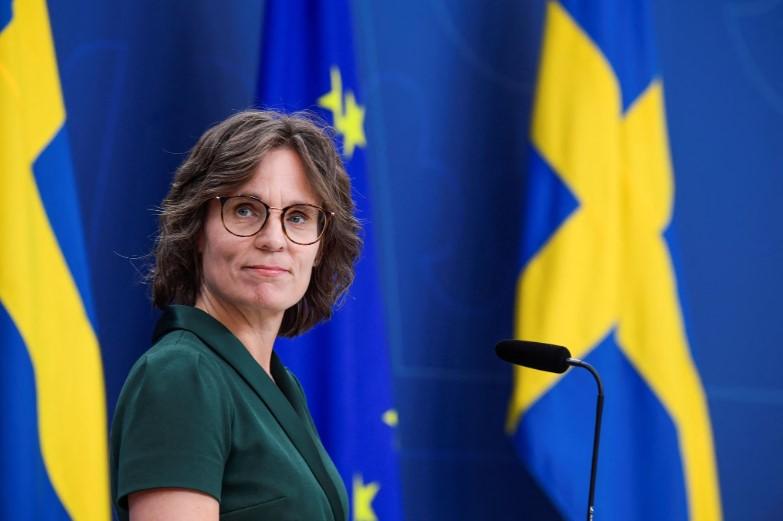
Swedish EU Minister Jessika Roswall
Europe’s push for expansion
The European Union is explicit about its ambitions. Aquaculture production reached nearly 1.1 million tons in 2023, generating €4.8 billion in value. Greece accounts for roughly 13% of that output, ranking among the bloc’s leading producers of Mediterranean species.
Yet Europe still imports more than 70% of the seafood it consumes. Viewing aquaculture as both an economic opportunity and a food security priority, Brussels has supported the sector with billions in EU funding earmarked for “sustainable” growth.
European Commissioner for Environment Jessika Roswall tells TO BHMA International Edition that “Aquaculture presents a high-growth investment opportunity driven by rising global demand for seafood,” but says expansion must remain within environmental limits.
“EU environmental laws already set clear rules to ensure that aquaculture develops in a responsible way. These rules protect marine ecosystems and biodiversity and make sure that aquaculture activities stay within safe environmental limits,” she adds.
Roswall informed TO BHMA that the Commission is now preparing additional practical guidance on fish farming, “with clear recommendations and real-life examples, including from Greece,” aimed at improving environmental performance and streamlining implementation.
On paper, the legislative and policy architecture is clear: grow production, protect biodiversity, simplify procedures. In practice, much depends on how national systems apply those rules.
Law versus implementation
Greece’s aquaculture framework dates to 2011 and formally aligns with EU environmental directives. In an effort to cluster farms, reduce spatial conflict and impose coordinated oversight, the law introduced 25 large POAYs nationwide.
More than a decade later, only half or so have been approved or are partially operational. Others, like the POAY around Rhodes, remain stalled in administrative review.
“There is nothing wrong with the law,” Greece’s General Secretary for the Environment Petros Varelidis tells TO BHMA International Edition. “The issue lies in implementation.”
As licensing shifts from individual sites to zonal planning, questions emerge about oversight capacity: who monitors the environmental thresholds, who enforces compliance, and who determines whether administrative systems can keep pace with expansion?
A growing environmental critique
Among those questioning the system is Eva Douzinas, president of the US-based Rauch Foundation, who became involved in Greek aquaculture debates after expansion plans surfaced near the island of Poros, where her family hails from.
Douzinas’s methodical, data-driven approach is almost forensic. Concentrating exclusively on open-net-pen finfish farming, she has commissioned independent technical reviews of environmental impact assessments (EIAs) to examine whether the modeling methods and biodiversity metrics used in Greece accurately capture cumulative ecological risk.
The studies, backed by expert testimony, argue that Greek EIAs routinely downplay ecological damage, obscure projections indicating that development plans will exceed safe environmental thresholds, and apply open-sea fish-farming models to semi-enclosed gulfs like Amvrakikos, to which they should not be applied.
As Douzinas puts it, talking to TO BHMA, an EIA is a critical step before approval is given for a fish farm or POAY, but “What’s the point of running a test if you don’t respect the results? The tests themselves are telling you there’s going to be severe damage.”
She argues that projects are approved nonetheless, because degradation is framed as occurring within a “small area,” without considering or clearly communicating “the cumulative impact of all of the farms in one place.” What the EIAs’ she has looked at say “with absolute certainty, is that if you go ahead with this production level, it’s going to be destructive. It’s going to create so much solid waste on the sea floor that it’s going to create an anoxic environment.” Yet the “EIAs are treated like an administrative checklist,” she tells TO BHMA, “not a tool to really assess if there’s going to be an environmental impact.”
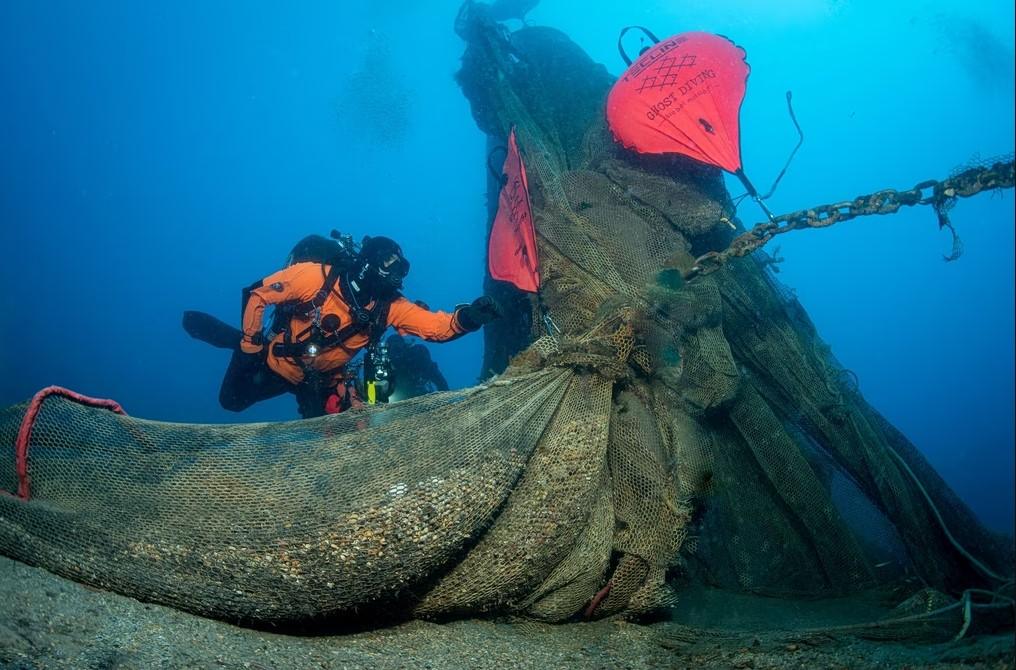
Divers of the environmental group Ghost Diving work next to ghost fishing nets, off the island of Ithaca, Greece, May 26, 2022. Kuyvenhoven/Ghost Diving/Handout via REUTERS ATTENTION EDITORS – THIS PICTURE WAS PROVIDED BY A THIRD PARTY TPX IMAGES OF THE DAY
Monitoring and accountability
Once a POAY is established, it is overseen by a managing body composed largely of representatives from the fish-farming companies that are already operating in the zone. “The people administering the POAY are the selfsame fish farmers who operate within it,” notes Anthi Giannoulou, a lawyer who has worked on the issue since 2020, while talking to TO BHMA. In most cases—with Evia representing a notable exception—local authorities have no formal role in POAY management.
This same managing body is also responsible for approving expansions and modifications, as well as overseeing environmental compliance. In addition, as Giannoulou points out “This governing body has the power to approve or deny the installation of other fish-farming operators within the zone,” creating an inherent conflict of interest and raising questions about competition and accountability.
An additional layer of complexity stems from European financial incentives. Under the European Maritime, Fisheries and Aquaculture Fund (EMFAF) 2021–2027, Greece is set to receive approximately €519.6 million, of which €363.7 million comes directly from the EU. A significant portion of the program is earmarked for sustainable aquaculture and marine environmental protection.
Beyond formal monitoring, the long-term environmental footprint of aquaculture is visible in abandoned infrastructure and fish farm waste carried by currents to nearby beaches.
Nonprofit organizations have stepped in to remove lost cages and industrial nets left behind after farms close or relocate. In a 2024 clean-up, the international group Healthy Seas recovered more than 42.7 tons of aquaculture debris from Greek waters, including plastic cages, floats and industrial nets linked to abandoned fish farms. The Greek nonprofit Aegean Rebreath has conducted parallel cleanups of ghost gear around former farm sites.
These operations are privately funded and volunteer-driven rather than embedded into regulatory obligations, highlighting a system where scientific monitoring exists but the restoration responsibilities for failed farms remain less clearly institutionalized.
Communities under pressure
For coastal communities, aquaculture is not an abstract policy debate. In Xiromero, western Greece, fish farms have been operating for over three decades. This relatively small municipality “is the fourth largest producer of farmed fish in Europe,” Douzinas tells TO BHMA. “With the proposed POAY expansion, this region will be second only to the whole of Spain.”
For Elina Makri, a representative of Aktaia, the issue is personal, too, as her father was from the area. Having grown up with its coastline as a constant reference point, she has seen the changes first-hand. And what industry representatives describe as growth has often felt like displacement for small-scale fishermen, she says.
This same imbalance gave rise to Aktaia, a national network linking local action committees from aquaculture-affected regions. “We realized that we were all running around separately,” she says, “so we united forces.” The group pools legal resources, dissects EIAs and campaigns. “We speak about the environmental damage and the social costs in ways local officials often cannot.”
Makri acknowledges the human stakes, as around 300 people in Xiromero work in aquaculture. “You can’t just say people will lose their jobs.” If the industry is not sustainable, she argues, retraining and credible alternatives must follow.
What frustrates her most is the façade of participation. Consultations take place, but EIAs often run to hundreds of highly technical pages. Residents attend hearings and submit comments, yet feel sidelined. One interim solution, she suggests, would be to relocate cages further from the shore, allowing the region to pursue tourism and small-scale enterprise in place of permanent industrialization.
Greek aquaculture is not a niche coastal activity. It is one of the country’s most export-oriented food industries and a cornerstone of Mediterranean fish production. According to the Hellenic Aquaculture Producers Organization’s 2025 annual report, Greece produced roughly 114,500 tons of seabass and seabream in 2024, generating €721 million in sales despite a slight decline in overall volume. About 82% of production—more than 94,000 tons—was exported to 38 foreign markets, underscoring the sector’s outward focus and its alignment with the EU’s ambition to strengthen Europe’s global aquaculture footprint.
However, industry analysts warn that regulatory uncertainty threatens long-term investment planning. The sector’s own report highlights delays in completing spatial planning frameworks, including POAY zones, as a constraint that “undermines the development goals set by the Government itself.” For major companies operating export-driven supply chains, this lack of predictable zoning and environmental governance constitute core financial risks.
For the industry, seabream and seabass aquaculture is framed as a strategic asset; “products of high nutritional value and export importance,” embedded in what it describes as a “modern, sustainable, and internationally competitive model of development, one that serves the national economy, consumers, and local communities alike.” For its critics, however, the scale of the proposed expansion magnifies existing risks: ecological strain in semi-enclosed seas, governance structures they view as opaque or self-policing, consultations that feel procedural rather than participatory, and decisions made far from the communities that live with their consequences.
Yet beyond the governance complexities, technical analysis and administrative details lies a broader yet simpler question: what kind of coastline does Greece want to shape in the decades ahead?
Η παράσταση «Η Ευτυχία της Αργιθέας» επιχειρεί να δώσει φωνή σε όσες ζωές έμειναν στο περιθώριο της Ιστορίας, χωρίς εξιδανίκευση και χωρίς διδακτισμό — μόνο με παρουσία.
Από την Πέμπτη 23 Απριλίου, το Δημοτικό Θέατρο Πειραιά κάνει μια βουτιά στον παλιό ελληνικό κινηματογράφο, με το έργο «Tζένη Τζένη - Ένα ηλιόλουστο Ρέκβιεμ»





![Άκρως Ζωδιακό: Τα Do’s και Don’ts στα ζώδια σήμερα [Πέμπτη 02.04.2026]](https://www.in.gr/wp-content/uploads/2026/04/zanyar-ibrahim-FjoVfeQCDSw-unsplash-315x220.jpg)















































 Αριθμός Πιστοποίησης Μ.Η.Τ.232442