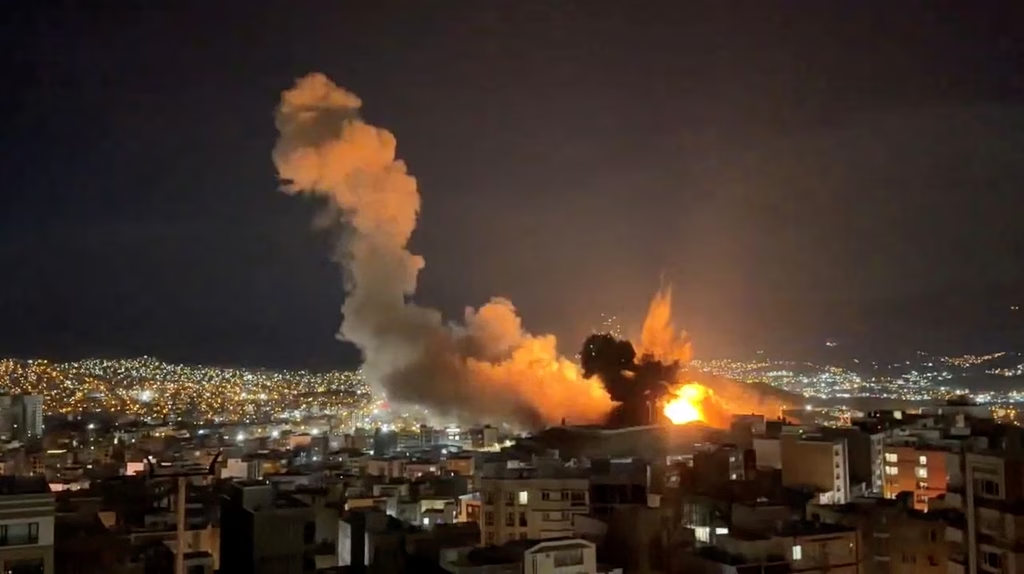
The Balkans was once known as the tinderbox of Europe, and it was no exaggeration. It was a region that served as the pretext for the outbreak of WWI with the assassination of Archduke Franz Ferdinand, and later was the site of the end of the last war in Europe.
In both WWI and WWII, history was fueled by nationalism. In the First World War it was a Serbian nationalist who killed the presumptive heir to the Austro-Hungarian throne. Much later, it was again nationalism that fueled the bloody breakup of Yugoslavia. Since then, nationalist passions have receded somewhat, but there are still loci that continually flare up.
We see it in Kosovo. We see it also in the Former Yugoslav Republic of Macedonia (FYROM), not with the national ex-PM Nikola Gruevski, but with his Atlanticist successor Zoran Zaev, who is now raising irredentist aims. In Albania, Prime Minister Edi Rama often plays the nationalist card. He went as far as to try to exploit the murder of a citizen of Albanian descent in Greece, only to find that the man was murdered by a compatriot.
Greece, too, which has at times fallen victim to nationalism, must not fall into this trap. The motive force of nationalism is insecurity about identity. Greece has a strong identity and knows how to behave calmly and prudently in the Balkan tinderbox.
Σε παγκόσμια πρώτη από τον καλλιτεχνικό οργανισμό Altera Pars το «Lost & Found» της Nalini Vidoolah Mootoosamy, σε μετάφραση και σκηνοθεσία Πέτρου Νάκου, συνεχίζει την πορεία του και μετά το Πάσχα.
Σύνταξη
WIDGET ΡΟΗΣ ΕΙΔΗΣΕΩΝΗ ροή ειδήσεων του in.gr στο site σας






![Άκρως Ζωδιακό: Τα Do’s και Don’ts στα ζώδια σήμερα [Δευτέρα 06.04.2026]](https://www.in.gr/wp-content/uploads/2026/04/aziz-acharki-jJbMgASm6l4-unsplash-315x220.jpg)















































 Αριθμός Πιστοποίησης Μ.Η.Τ.232442