
Mind the Gap: Greek Wages Trail Europe Once Again
Eurostat’s 2024 data show Greece posting the EU’s second-lowest median wage, outpacing only Bulgaria and remaining well below the European average





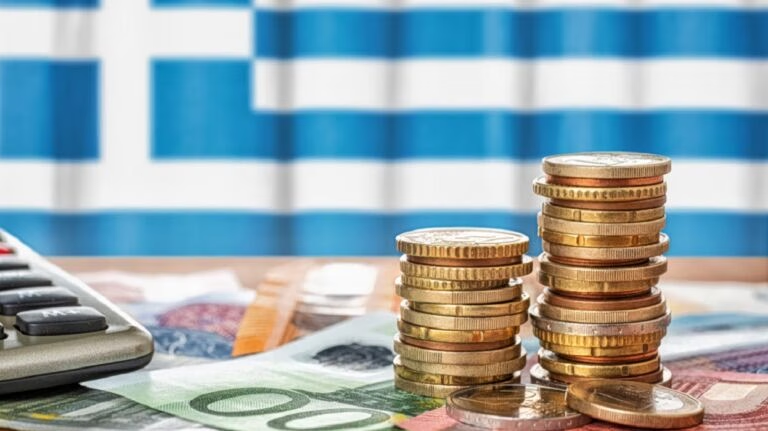
Greece has recorded the European Union’s second-lowest median annual wage for full-time employees, according to new data published by Eurostat for 2024.
The median gross annual wage in Greece stood at €17,954, only slightly above Bulgaria’s €15,400, placing the country near the bottom of the EU’s pay scale. Hungary followed closely with €18,500.
While wages in Greece rose by €884—a 5% increase from €17,070 in 2023—the growth was not enough to narrow the gap with the rest of Europe. Across the EU, the median annual wage reached €39,800, marking a 5.2% year-on-year rise.
The difference remains stark. The average Greek worker earns 4.5 times less than a full-time employee in Luxembourg (€83,000), 3.4 times less than in Ireland (€61,100), and more than twice less than the EU average. Even several newer EU members—Romania (€21,108), Slovakia (€20,287), and Poland (€21,246)—now report significantly higher wages.
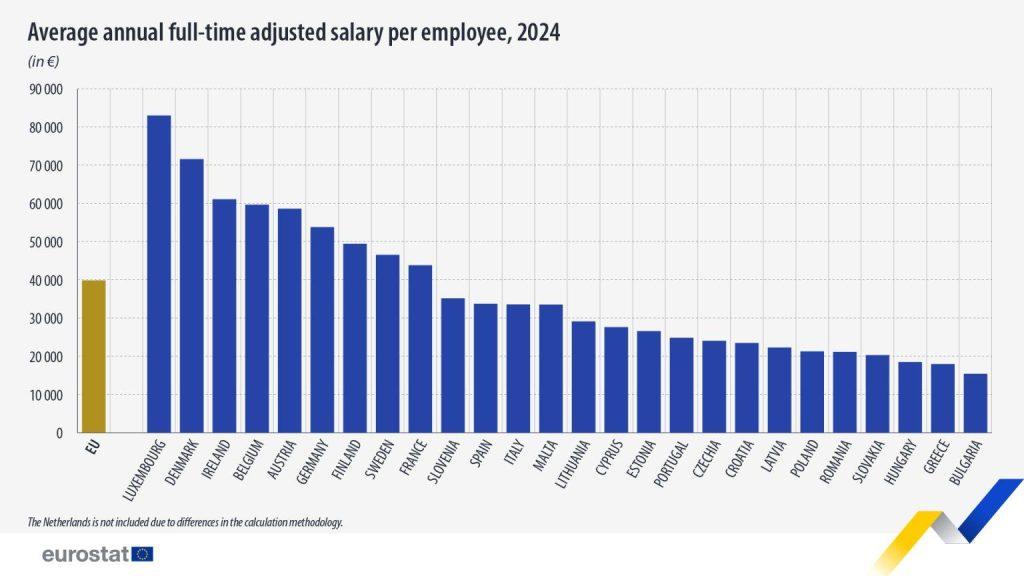
At the top of the European ranking, Luxembourg, Denmark (€71,600), and Ireland continue to lead, reflecting the persistent wage divide across the bloc.
When it comes to minimum wages, the trend is similar. According to the Alpha Bank Economic Bulletin, Eurostat data show that all EU countries except Cyprus recorded increases between July 2024 and July 2025. The largest nominal rises occurred in Central European states—between 10.2% and 15.5%—while Greece’s minimum wage grew by a more modest 6.1%.
The bulletin also highlights changes in the Kaitz index, which measures the ratio of minimum to median or average wages. While the index rose across most EU member states in 2023, only a few have reached the levels recommended in EU Directive 2022/2041—that is, 60% of the median or 50% of the average wage.
Despite incremental progress, the data underscore a familiar reality: Greece remains near the bottom of the European wage hierarchy. The slow pace of income convergence—relative to both Western and newer Central European economies—illustrates how far the country still has to go to rebuild purchasing power and competitiveness after years of economic adjustment.
Source: tovima.com
- Λονδίνο: Εμπρηστική επίθεση σε κτίριο εβραϊκής οργάνωσης – Έβαλαν φωτιά σε τρία ασθενοφόρα
- O Ντόναλντ Ντακ και η ενεργειακή κρίση: Τι μας δίδαξαν τα Μίκυ Μάους για όσα συμβαίνουν σήμερα
- «Το Τάμα» με τον Γιώργο Χριστοδούλου για 10 παραστάσεις στο Σύγχρονο Θέατρο
- Αρκάς: Η καλημέρα της Δευτέρας και της άνοιξης
- Λιμανάκια Βουλιαγμένης: Δραματικές έρευνες για τον 34χρονο δύτη που αγνοείται
- Όλα όσα προσφέρει το μάνγκο στον οργανισμό μας
- Ξεκινά η ιστορική δίκη για τα Τέμπη με 36 κατηγορούμενους – Δικαιοσύνη και στήριξη ζητούν οι συγγενείς
- «Οδηγός» για τον ΕΝΦΙΑ: Όλα όσα πρέπει να ξέρετε

Ακολουθήστε το in.gr στο Google News και μάθετε πρώτοι όλες τις ειδήσεις
![Άκρως Ζωδιακό: Τα Do’s και Don’ts στα ζώδια σήμερα [Δευτέρα 23.03.2026]](https://www.in.gr/wp-content/uploads/2026/03/jocke-wulcan-N_9yLWF3ikU-unsplash-1-315x220.jpg)




















































































 Αριθμός Πιστοποίησης Μ.Η.Τ.232442