The political blow from the disastrous Attica wildfires was great. It is not just the magnitude of the catastrophe and the losses, but the manner in which the government behaved
Sometimes, plans that look good on paper turn out to be inadequate in practice, especially when reality takes unforeseen turns.
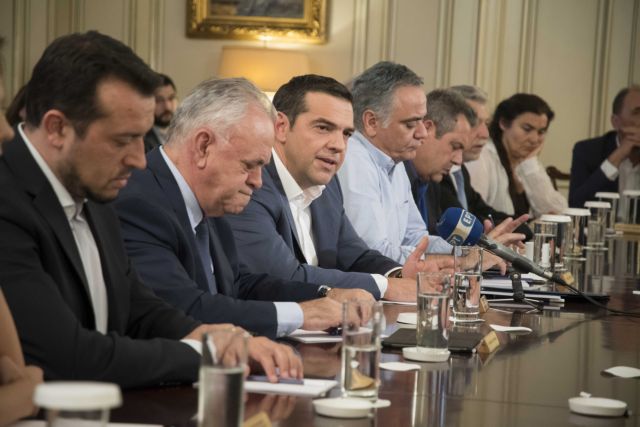
Clearly, the government since the end of 2017, and possibly earlier, had begun political and electoral planning, that would allow SYRIZA to wage the electoral battle on the best possible terms.
The electoral target was not achieving first place, as it was known early on, shortly after the September, 2015 elections, that New Democracy acquired an electoral lead, which it has not lost since then.
The electoral target was to guarantee second place, with a percentage considerably above 20 percent, which would guarantee that SYRIZA would be the main opposition, and which would give it in a later phase, the possibility of returning as government.
The view of SYRIZA cadres was and is that such a percentage would ensure that SYRIZA would be the basic, second pole in the emerging, post-memorandum two-party dominance, and that it would be the leader in the broader, progressive, centre-left, and social democratic part of the political spectrum.
SYRIZA’s plans on paper
In this direction, the government made specific choices.
Firstly, it decided, already by the bailout evaluation of 2017, that it would pass into law all the bailout measures and would satisfy the demands of creditors, with the aim of ensuring that in August, 2018, it could announce the “exit from the memorandums”, so that Alexis Tsipras could hold elections proclaiming that he succeeded in doing what all previous governments failed to do.
In fact, what the government did was to exploit the receding social protests, and the fatigue from all the social clashes of the previous years, and to legislate what previous governments could not.
Secondly, it attempted to build closer ties with segments of the electorate. A characteristic example is the government’s stance towards civil servants. Despite the clashes with specific ministries – such as the permanent dispute between the National Association of Workers at Public Hospitals and Alternate Health Minister Pavlos Polakis – the government invested in the fact that on its watch, the position of public servants was not worsened or jeopardised.
The situation for civil servants may have not improved substantially, but they avoided transfers and layoffs. The government often reminded the public of Kyriakos Mitsotakis tenure as interior minister, and the measures that he took.
Another characteristic example was the various benefits that the government handed out to vulnerable segments of society. Despite the fact that indices of inequality did not improve, the government insisted on measures such as the solidarity card and the reorganisation of family benefits.
In a similar fashion, the government invested for electoral reasons in measures regarding family law. The most characteristic example was the extension of civil partnership agreements to same-sex couples, and the recognition of gender identity. The aim here was to lure dynamic and relatively young segments of society, which are attracted by moves of institutional modernisation. At the same time, New Democracy, despite the liberal positions of its leader, remains conservative on certain issues.
The third step that the government invested in was resolving the FYROM naming issue. Here, there was a dual objective. One was to ensure Alexis Tsipras’ image as a responsible and “visionary” leader, who not only leads the country out of the bailout memorandums, but who also solves national issues that had long festered. On the other hand, the government believed that the reactions would be limited to the extreme right of the political spectrum, which could possibly fuel the creation of a party to the right of New Democracy that would stem New Democracy’s gains in developing a social dynamic.
The inability to read society
These plans, however, appear to have been made without the approval of the people.
Firstly, the government in order to achieve the formal exit from the memorandums had to commit itself to measures that were tantamount – as broad swathes of society believe – to an extension of the memorandums. The key here is the annihilating primary surpluses, pension cuts, and the decline in the tax-free threshold.
Moreover, they did not calculate the reactions to the FYROM issue. Here, there were successive errors in the handling and judgment of the affair.
Conducting a large part of negotiations with secret diplomacy, and motivated by the insistence of the US to change the political balances in the Western Balkans, the SYRIZA-Independent Greeks government did not open the issue in a timely manner. It did not prepare society for the need for a dignified compromise on an issue regarding which a large part of the electorate grew up with the idea that “Our name is our soul”.
Then the government, which has in its ranks the especially capable analyst of political tendencies Christophoros Vernardakis, could not evaluate in a timely manner, the negative stance throughout Greek society.
A majority of society that experienced the trials of the memorandums, which for a long time sought ways to survive, and which felt that the previous period was humiliating, saw the “compromise” on the FYROM name as an unacceptable retreat that added to a wider series of practices that reduced national sovereignty.
This is why all opinion polls agree that the FYROM naming issue had a negative electoral impact on SYRIZA, especially in northern Greece.
There is an additional parameter. SYRIZA is a party with a small organisational grounding in society. It does not have the large, nationwide party machines, and the trade union and local government representation that New Democracy and the Movement for Change have.
The largest number of SYRIZA cadres has been appointed to positions in the state and government. It is thus unable to receive messages from the grass roots, which for example the Greek Communist Party (KKE) can. That explains why there are incorrect evaluations of crucial choices.
Let us not forget that SYRIZA came to power by riding on a wave of social protest which it had not created, but which it simply represented.
Wildfires as a negative catalyst
With this background, the political blow from the disastrous Attica wildfires was great. It is not just the magnitude of the catastrophe and the losses, but the manner in which the government behaved.
The effort to cover up responsibilities, the reluctance to engage in self-criticism and admit mistakes, the various communications ploys that reminded one of the catastrophic fires in 2007 which were attributed to “asymmetrical threats” and the “[army] general wind” by minister Vyron Polydoras, and the cynical effort to attribute responsibility to the victims themselves, all created an especially negative climate.
All this may not have yet been registered in the polls, but everyone believes that it will be.
There are two reasons for this. Natural disasters and the ability to limit their impact concern not only the “vision” or “programme” of a party, but also its capacity to manage the crucial core of the state’s function – the protection of life.
This is all the more true with disasters such as wildfires, for which society considers it a given that the state machine can avert human victims, even if it cannot avert the fire itself.
Let us be clear. It is not obligatory that every natural disaster should lead to the political trouncing of the government.
The Simitis government was confronted in the 1997-1999 period with a very large wave of social dissatisfaction with major mobilisations (farmers’ blockades, a protracted OLME teachers’ union strike, student sit-ins, and anti-war protests).
Still, it managed to win the 2000 elections, partly because of the image of effective management that it displayed in handling the large Attica earthquake in 1999.
In the case of SYRIZA, the image of the collapse of the state machine and of management solely with communications efforts of such a national tragedy, leads to the exactly opposite result. It leads to the loss of the remaining electoral support that the ruling party may have maintained.
It is the distance that separates defeat that can be a launch pad for a dynamic political return, from a crushing electoral defeat, which signals the end of the road for a party and its leader.








![Άκρως Ζωδιακό: Τα Do’s και Don’ts στα ζώδια σήμερα [Δευτέρα 30.03.2026]](https://www.in.gr/wp-content/uploads/2026/03/paul-pastourmatzis-36plOdZK_uY-unsplash-315x220.jpg)











































 Αριθμός Πιστοποίησης Μ.Η.Τ.232442