





Source: tovima.com
Undeclared Work in Greece Remains Above EU Average
New report highlights persistent informal employment, with women in rural areas most affected despite a gradual decline over the past decade.
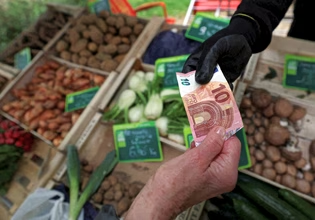
Undeclared work in Greece remains significantly above the European Union average, according to a new report by Foundation for Economic and Industrial Research, underscoring a persistent challenge for the country’s labor market.
The study finds that informal employment stood at 3.5% in 2024, compared to the EU-23 average of 2.7%. While the rate has declined steadily since 2010, it continues to exceed European levels and reflects ongoing structural issues in the economy.
Women and rural areas most affected
The report highlights stark gender and regional disparities, with women disproportionately impacted—especially outside urban centers. In non-urban areas, informal employment reaches 8.1% among women, compared to 3.9% for men. In cities, the figures are lower but still uneven, at 3.9% for women and 2.1% for men.
Greece also records a wider gender gap in undeclared work than the EU average, reinforcing concerns about inequality in the labor market.
Rising violations despite stricter controls
Authorities continue to uncover widespread violations. In February alone, six out of ten fines issued by labor inspectors were linked to undeclared work and breaches of the digital work card system. Out of €4 million in total penalties, €2.4 million were tied to these offenses.
Fines for undeclared employment can reach up to €10,500 per worker, yet a significant portion of the market still operates in violation of labor regulations.
Broader economic and social impact
Informal employment includes a wide range of workers, from self-employed individuals operating outside formal structures to employees whose work is not officially recognized by employers. These workers often lack access to essential protections such as health insurance, pensions, and collective bargaining rights.
Experts warn that this lack of regulation has far-reaching consequences, affecting both worker welfare and fair competition within the economy.
Slow progress, ongoing challenges
Although reforms—such as reduced labor taxes, lower social security contributions, the introduction of a digital work card, and increased inspections—have contributed to a gradual decline, the problem persists.
The report notes that undeclared work, particularly among women and in rural regions, remains a significant social and economic issue. It calls for targeted policies to improve labor protections and promote equality, emphasizing the need for sustained efforts to bring more workers into the formal economy.
Headlines:
- Συναγερμός για φωτιά στην Κεφαλονιά – Ήχησε το 112
- Λήξη συναγερμού στον Πειραιά – Δεν εντοπίστηκε διαρροή αερίου
- Ο Ντόναλντ Τραμπ απειλεί το Ιράν με πλήγματα σε πολιτικές και ενεργειακές υποδομές – Ακόμη και στην Τεχεράνη
- Το σπίτι όπου γεννήθηκε ο Χίτλερ στην Αυστρία έγινε αστυνομικό τμήμα
- «Πλησιάζει σε deal με την Γκενκ για τον Καρέτσα η Ντόρτμουντ – Ανέβασαν την προσφορά τους οι Βεστφαλοί»
- Μπλακ άουτ σε Κυψέλη, Εξάρχεια, Κολωνάκι και Γκύζη – Εγκλωβισμοί σε ασανσέρ και σβηστά φανάρια
- Μνημόνιο Συνεννόησης μεταξύ του ΙΔΡΥΜΑΤΟΣ «ΚΛΕΩΝ ΤΣΕΤΗΣ» και του NANOPOULOS FOUNDATION
- Κουφονικολάκου: Μια προοδευτική κυβέρνηση οφείλει να στραφεί στη θωράκιση του δημόσιου εκπαιδευτικού συστήματος
Δείτε όλες τις Τελευταίες Ειδήσεις από την Ελλάδα και τον Κόσμο, στο in.gr

Ακολουθήστε το in.gr στο Google News και μάθετε πρώτοι όλες τις ειδήσεις
![Άκρως Ζωδιακό: Τα Do’s και Don’ts στα ζώδια σήμερα [Τετάρτη 22.07.2026]](https://www.in.gr/wp-content/uploads/2026/07/guilherme-stecanella-NT2jndF5Vpo-unsplash-1-315x220.jpg)