Greece’s Offshore Energy Drive Enters Critical Phase
From the final quarter of 2026, and most likely beginning in October, seismic surveys are expected to commence under the joint venture between Chevron and HELLENiQ ENERGY
Greece’s hydrocarbons program is set to enter a decisive new phase over the next six months, with two major milestones between October 2026 and February 2027 that could reshape the country’s energy landscape and strengthen Europe’s supply diversification.
At the center of developments are both extensive offshore seismic surveys and the country’s first exploratory drilling in four decades—steps that signal a renewed push to assess Greece’s undersea natural resources at scale.
Chevron-led seismic campaign across four offshore blocks
From the final quarter of 2026, and most likely beginning in October, seismic surveys are expected to commence under the joint venture between Chevron and HELLENiQ ENERGY. The program covers four offshore blocks—“Block A2,” “South of Peloponnese,” “South Crete I,” and “South Crete II”—all leased through concession agreements with the Greek state.
The surveys, typically carried out between October and December due to favorable seasonal conditions, will begin with two-dimensional subsurface imaging to map geological structures across the licensed areas.
Operations are expected to start in Block A2 before moving to the South of Peloponnese, with the two Cretan blocks to follow in the first half of 2027.
After the data is analyzed, the consortium plans to conduct more targeted three-dimensional seismic surveys in 2027, focusing on the most promising geological formations for potential hydrocarbon deposits.
Historic drilling set for February 2027
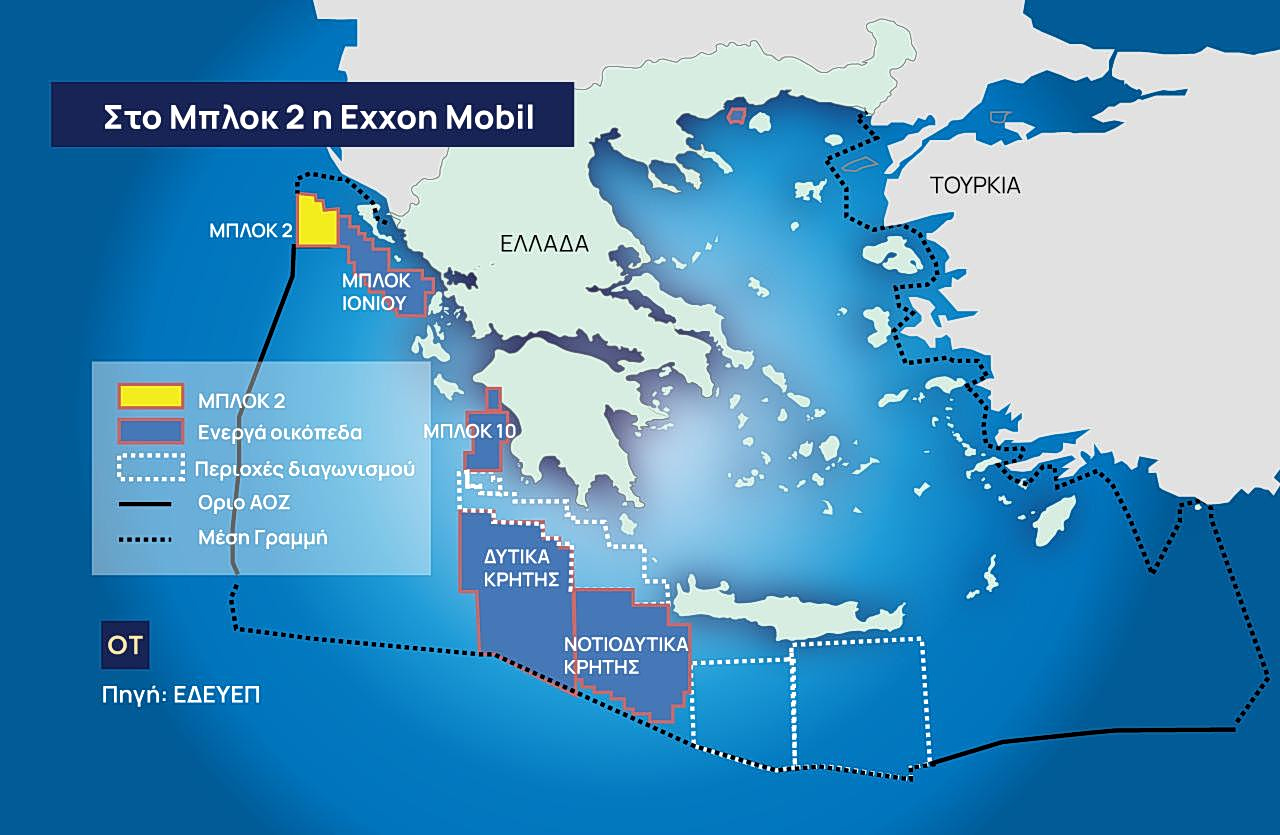
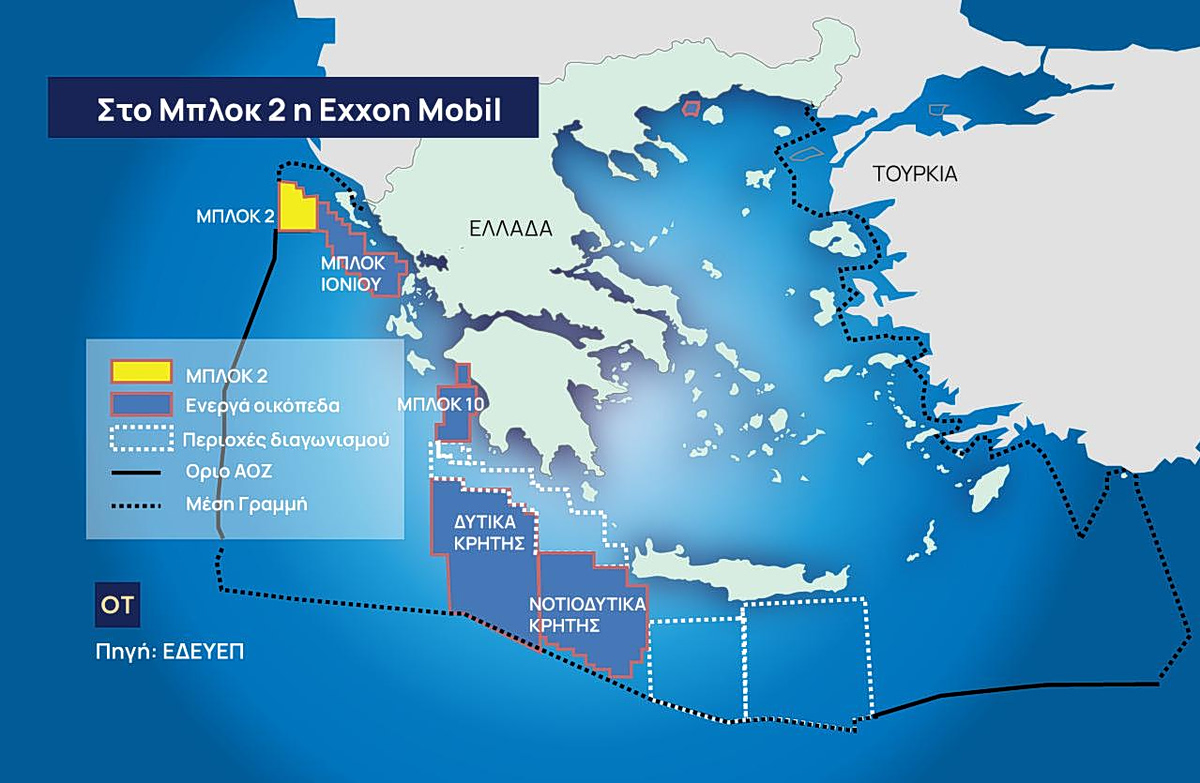
Between 14 and 24 February 2027, Greece is set to carry out its first offshore exploratory drilling in 40 years. The project, led by Energean in partnership with ExxonMobil and HELLENiQ ENERGY, will take place in Block 2 in the northwestern Ionian Sea, targeting the “Apostolos 1” prospect.
The operation, will involve drilling to depths of up to 4,622 meters in search of natural gas. Preliminary estimates suggest potential resources of around 270 billion cubic meters, with possible investments of 5 billion euros and overall economic benefits for Greece estimated at about 10 billion euros if confirmed.
Future concessions also under review
Alongside the Chevron and ExxonMobil–Energean projects, Greek energy planners are also examining additional licensing opportunities. The Ministry of Environment and Energy and HEREMA are reviewing areas where exploration was previously incomplete or returned to the state, including the Patras Gulf and Ioannina blocks.
Μετά τη sold out συναυλία στο Λυκαβηττό, τα αγαπημένα τραγούδια του Θάνου Μικρούτσικου ταξιδεύουν στη Θεσσαλονίκη. Την Παρασκευή 4 Σεπτεμβρίου στη Μονή Λαζαριστών











![Άκρως Ζωδιακό: Τα Do’s και Don’ts στα ζώδια σήμερα [Πέμπτη 23.07.2026]](https://www.in.gr/wp-content/uploads/2026/07/bin-thieu-XBMFKFLxlzw-unsplash-1-315x220.jpg)