Macron, Merz Push to Revive Franco-German Defense Ties
France and Germany deepen military cooperation, with Berlin joining a French nuclear exercise for the first time as they move past the failed FCAS jet program
France and Germany are deepening their defense partnership, with particular focus on nuclear deterrence, as the two countries also try to move past the collapse of their joint FCAS next-generation fighter jet program.
Germany set to join France’s nuclear umbrella
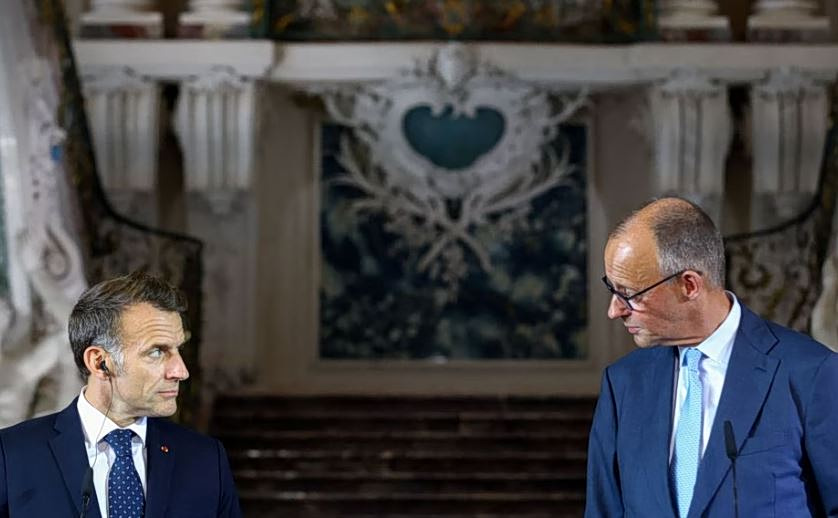
During French President Emmanuel Macron‘s official visit to Germany, Chancellor Friedrich Merz announced that German forces would take part “this year” in a French nuclear military exercise, calling it a symbolic step toward strengthening European deterrence.
Speaking from Brühl, near Cologne, Merz said Germany and France are deepening defense cooperation and reinforcing European deterrence, adding that German forces would join a nuclear exercise with the French armed forces starting this year. He clarified that this participation complements, rather than replaces, Germany’s continued commitment to NATO’s nuclear deterrence framework.
Macron, for his part, noted that Germany is among eight countries that have agreed to take part in France’s initiative on European nuclear deterrence. He reiterated that France, one of Western Europe’s two nuclear powers alongside the UK, would retain full control over decisions on the use of its nuclear arsenal.
For Macron, progress on this front carries added weight ahead of next spring’s presidential election, in which far-right leader Marine Le Pen is seen as a leading contender to succeed him. A potential Le Pen presidency adds another layer of uncertainty for European countries already speeding up their defense buildup in response to the Russian threat and reduced US commitment under President Donald Trump.
Searching for the “soul” of the Franco-German axis
The two leaders first visited Nörvenich air base near Cologne, arriving by Super Puma helicopter, an aircraft held up as an example of successful Franco-German defense cooperation. There, they held a joint Defense and Security Council meeting alongside a French Rafale jet and a German air force Eurofighter, a staged backdrop meant to signal unity.
They then held a joint cabinet meeting at a castle near Cologne, the same historic site where Charles de Gaulle and Konrad Adenauer agreed in 1962 on the idea for the Franco-German friendship treaty. The two governments are trying to inject new momentum into their bilateral relationship a month after the collapse of the joint Future Combat Air System (FCAS) program, which stalled amid disputes between Airbus and France’s Dassault. Similar tensions surround the joint Main Ground Combat System (MGCS) tank program, which has faced internal friction since Germany’s Rheinmetall joined the project.
The talks also touched on disagreements over European air defense. Germany continues to back the European Sky Shield Initiative, built mainly around American Patriot systems and the Israeli-American Arrow-3. France has declined to join, arguing it increases European dependence on the United States and that Europe should invest more in its own defense industry.
What the two leaders discussed
Following the FCAS failure, Paris and Berlin agreed to work toward a common standard ensuring interoperability across all aerial combat systems, from drones to fighter jets.
The joint meeting’s agenda also covered European competitiveness, the EU budget, digital legislation, and efforts to counter disinformation.
Artificial intelligence received particular attention, with both countries seeking joint initiatives to help Europe compete with the US and China by pooling computing infrastructure and creating a mechanism to attract top researchers.
Macron said the two countries had “learned a lesson” from the FCAS failure and would now pursue more narrowly targeted joint defense projects, with political leadership working closely alongside industry to avoid similar deadlocks. Plans include cooperation on advanced battery development, a joint AI center, and a partnership between public broadcasters Deutsche Welle and France Médias Monde to combat disinformation.









![Άκρως Ζωδιακό: Τα Do’s και Don’ts στα ζώδια σήμερα [Σάββατο 18.07.2026]](https://www.in.gr/wp-content/uploads/2026/07/ian-nicole-reambonanza-CICFJEHWiFY-unsplash-315x220.jpg)